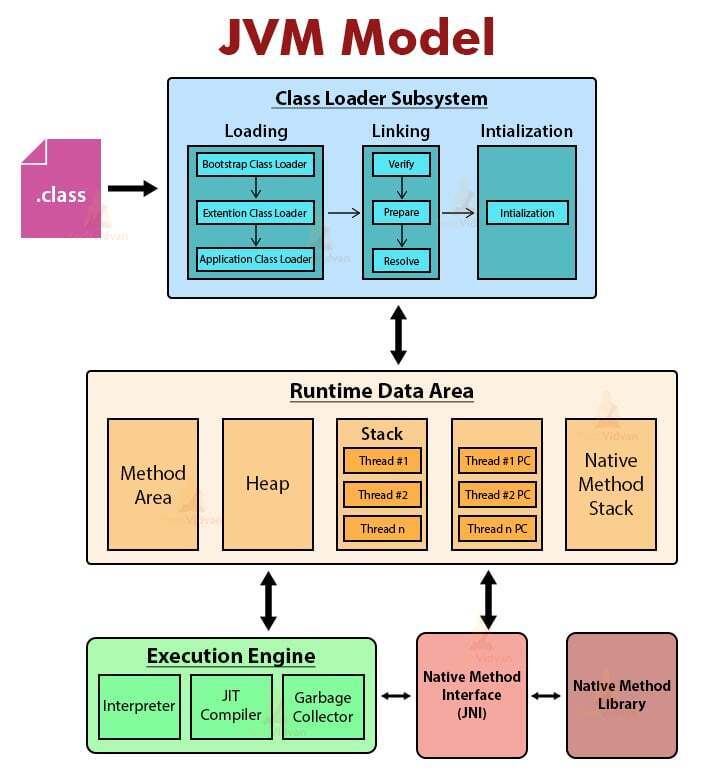
The Java Virtual Machine (JVM) is the backbone of the Java ecosystem. It abstracts the hardware and operating system, allowing Java applications to run on any platform.
JVM Architecture
+-----------------------------+
|    Class Loader Subsystem  |
+-----------------------------+
|     Runtime Data Areas      |
|  - Method Area              |
|  - Heap                     |
|  - Java Stack               |
|  - PC Register              |
|  - Native Method Stack      |
+-----------------------------+
|     Execution Engine        |
+-----------------------------+
|     Native Interface (JNI) |
+-----------------------------+
|     Native Method Libraries |
+-----------------------------+
Class Loading
Bootstrap ClassLoader
Extension ClassLoader
Application ClassLoader
ClassLoader classLoader = MyClass.class.getClassLoader();
System.out.println(classLoader.getClass().getName());
Memory Areas
Heap: For all class instances and arrays.
Stack: For method calls and local variables.
Method Area: Stores class-level data like method definitions.
⚠️ Heap and Stack are managed differently—stack is LIFO and thread-confined; heap is shared.
JIT Compiler
The Just-In-Time Compiler improves performance by compiling bytecode to native machine code at runtime.
Interpret → Profile → Compile → Inline → Optimize
Garbage Collection
Java automates memory management via Garbage Collection (GC). Common GC algorithms include:
Serial GC
Parallel GC
G1 GC
ZGC
💬 You can tune GC via JVM options like
-XX:+UseG1GC
Conclusion
Understanding JVM internals is crucial for writing efficient, scalable Java applications.
🧠 Remember: What runs your code matters just as much as the code itself.